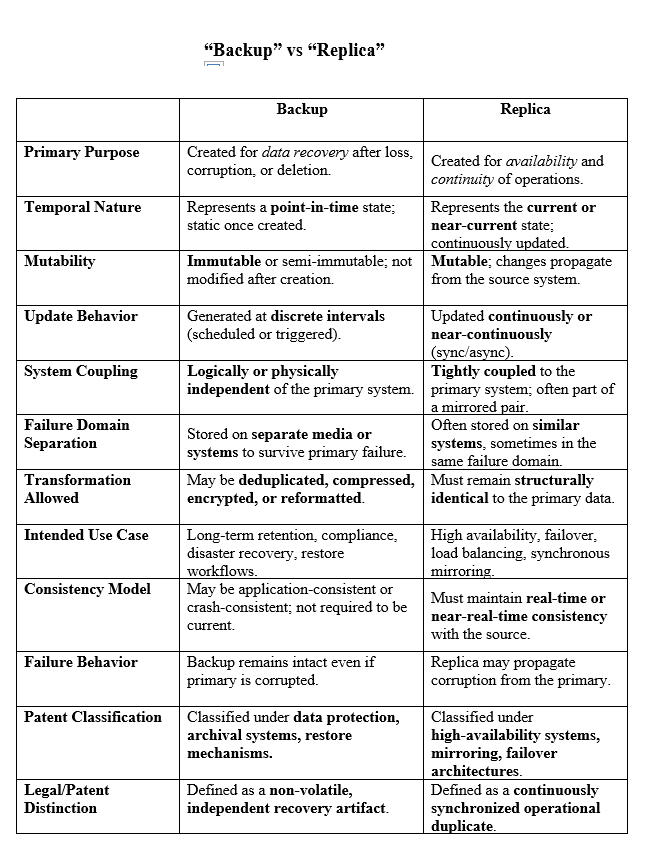
At a patent level, the distinction comes down to purpose, state, and behavior of the data copy.
Below is the crisp, legally meaningful differentiation.
1. Purpose (the biggest patent differentiator)
Backup = for recovery
A backup exists to restore data to a previous point in time after loss, corruption, or deletion.
Patent language often describes backups as:
- “non‑volatile copies for long‑term retention”
- “point‑in‑time recovery artifacts”
- “copies stored independently from the primary system”
Replica = for availability
A replica exists to keep a system running, not to restore it later.
Patent language describes replicas as:
- “synchronously or asynchronously mirrored data”
- “copies used for failover or high availability”
- “continuously updated duplicates”
Patent distinction:
Backups = recovery
Replicas = continuity
2. Mutability and Independence
Backup
- Immutable or semi‑immutable
- Stored separately (logical or physical separation)
- Not continuously updated
- Often deduplicated, compressed, or transformed
Replica
- Mutable (changes propagate)
- Tightly coupled to the source
- Continuously or frequently updated
- Must remain consistent with the primary
Patent distinction:
Backups = independent, static copies
Replicas = dependent, dynamic copies
3. Timing and Update Behavior
Backup
- Created at discrete intervals
- Represents a point in time
- Not updated after creation
Replica
- Updated continuously or near‑continuously
- Represents the current state
- May be synchronous or asynchronous
Patent distinction:
Backups = snapshot in time
Replicas = ongoing reflection of current state
4. Storage Location and Separation
Backup
- Often stored on different media
- Often stored in different systems or clouds
- Designed to survive primary system failure
Replica
- Often stored on similar or identical systems
- May be in the same cluster or same vendor ecosystem
- Designed for fast failover, not disaster survival
Patent distinction:
Backups = separated for survivability
Replicas = co‑located for availability
5. Patent Classification Behavior
Patent examiners typically classify:
Backup inventions under:
- Data protection
- Archival systems
- Point‑in‑time copy management
- Long‑term retention
- Restore workflows
Replica inventions under:
- High‑availability systems
- Failover mechanisms
- Synchronous/asynchronous mirroring
- Clustered storage
- Disaster‑tolerant architectures
This classification difference is critical because it determines prior art, novelty, and obviousness.
Summary
A backup is a point‑in‑time, independent, immutable copy created for recovery, while a replica is a continuously updated, dependent, mutable copy created for availability.
This is the distinction patent attorneys rely on when drafting claims.
- Often stored on similar or identical systems
- May be in the same cluster or same vendor ecosystem
- Designed for fast failover, not disaster survival
Patent distinction:
Backups = separated for survivability
Replicas = co‑located for availability
The table shows how “backup” and “replica” differ in the eyes of patent examiners, IP attorneys, and technical claim language. This is written in the style used in patent filings and prior‑art analysis — focusing on purpose, behavior, independence, mutability, timing, and system relationships.