
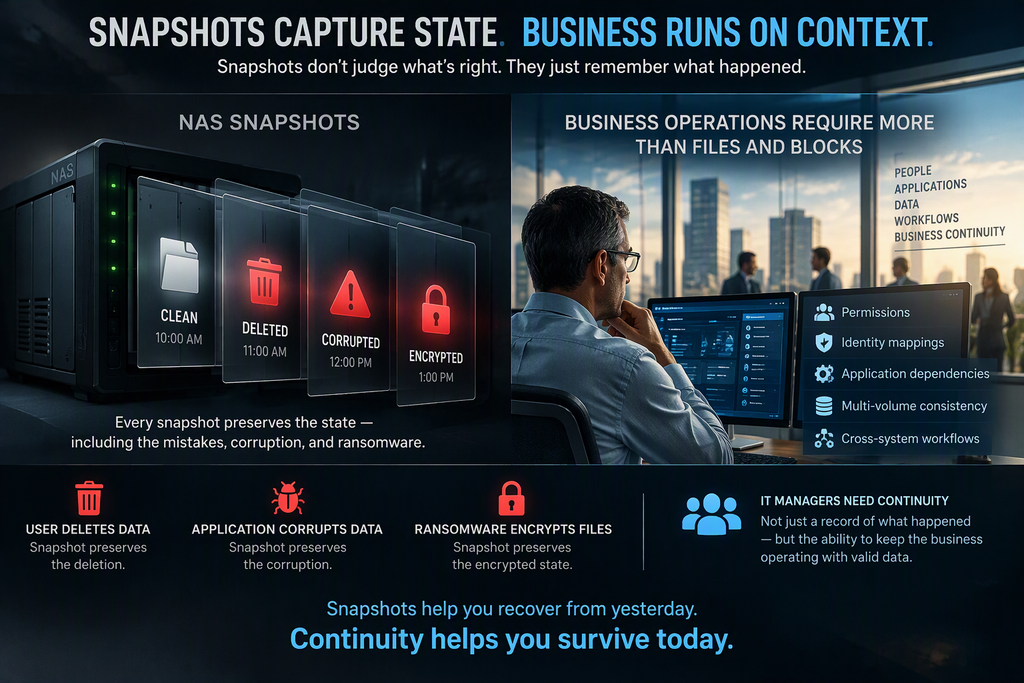
Snapshots Preserve Corruption Perfectly
This is the limitation many organizations discover too late.
Snapshots don’t understand good data versus bad data.
They preserve state.
If a user accidentally deletes data, snapshots preserve the deletion.
If an application corrupts data, snapshots preserve the corruption.
If ransomware encrypts files, snapshots preserve the encrypted state.
Snapshots are excellent historians.
They are terrible judges.
They record what happened.
They don’t determine whether what happened was correct.
Snapshots Don’t Understand Context
A snapshot captures files and blocks.
Businesses operate on relationships.
Consider:
- Permissions
- Identity mappings
- Application dependencies
- Multi-volume consistency
- Cross-system workflows
Snapshots do not inherently understand those relationships.
They capture storage state.
They do not capture operational reality.
That gap becomes painfully visible during recovery.
Why the Industry Keeps Returning to Snapshots
Because they’re useful.
Snapshots solve real problems.
They reduce operational pain.
They accelerate recovery.
They improve resilience.
But solving recovery and solving continuity are different objectives.
The industry has spent decades optimizing recovery.
The next architectural challenge is continuity.
Why?
Snapshots help you recover from yesterday.
Continuity helps you survive today.